
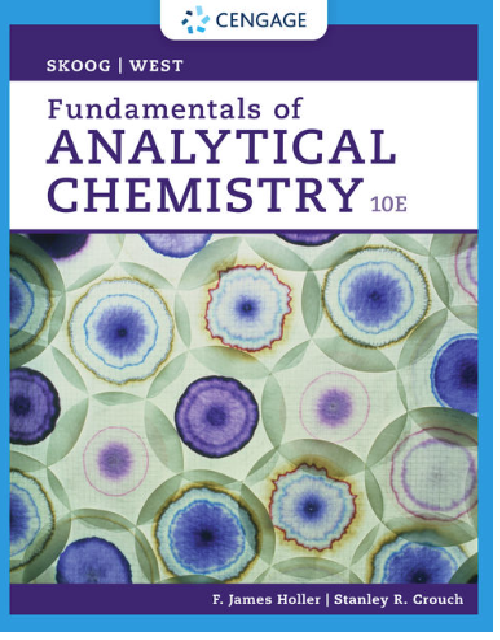
Fundamentals of Analytical Chemistry
"Fundamentals of Analytical Chemistry" by Douglas A.
Skoog, Donald M. West, and F. James Holler**
"Fundamentals of Analytical Chemistry" by Douglas A. Skoog, Donald
M. West, and F. James Holler is a highly respected textbook in the field
of analytical chemistry. First published in 1982, it has undergone several
editions, each building on the previous one while maintaining its
reputation as a comprehensive and accessible guide for both students and
professionals. This review explores the strengths, structure, and
applicability of the text, assessing its contribution to the study of
analytical chemistry.
### Content and Structure
The textbook is divided into several parts, with each part focusing on
different aspects of analytical chemistry. The first few chapters lay a
solid foundation in the fundamental principles of analytical chemistry.
Topics such as the nature of analytical chemistry, measurement
techniques, error analysis, and statistical methods in analysis are
introduced in a straightforward, digestible manner. This is crucial for
students who are new to the field, as these chapters provide the necessary
background for more advanced topics.
One of the key features of this book is its structured approach to
explaining the various analytical techniques. The authors cover a wide
range of methods, including classical and modern techniques, such as
spectrophotometry, chromatography, electrophoresis, and mass
spectrometry. Each chapter provides detailed explanations of the
underlying principles of these techniques, how they are performed, and
their applications in real-world scenarios. The book doesn't just provide
theoretical knowledge; it emphasizes the practical aspects, making it
useful for laboratory work.
Another strength of "Fundamentals of Analytical Chemistry" is its
coverage of the importance of chemical measurements and their
limitations. The authors thoroughly discuss the various types of errors
that can occur in analytical measurements, such as random errors,
systematic errors, and instrumental errors. They also provide guidance on
how to minimize these errors and interpret data accurately. This focus on
error analysis makes the book an invaluable resource for students looking
to understand the intricacies of conducting experiments and analyzing
results.
The later chapters in the book delve into more specialized techniques and
modern instrumentation. The authors skillfully explain complex topics
such as atomic absorption spectroscopy, nuclear magnetic resonance, and
mass spectrometry, presenting them in a way that is both accessible and
informative. For students pursuing careers in analytical chemistry, these
chapters provide crucial knowledge that is applicable in both academic
and industrial settings.
"Fundamentals of Analytical Chemistry" by Douglas A.
Skoog, Donald M. West, and F. James Holler**
"Fundamentals of Analytical Chemistry" by Douglas A. Skoog, Donald
M. West, and F. James Holler is a highly respected textbook in the field
of analytical chemistry. First published in 1982, it has undergone several
editions, each building on the previous one while maintaining its
reputation as a comprehensive and accessible guide for both students and
professionals. This review explores the strengths, structure, and
applicability of the text, assessing its contribution to the study of
analytical chemistry.
### Content and Structure
The textbook is divided into several parts, with each part focusing on
different aspects of analytical chemistry. The first few chapters lay a
solid foundation in the fundamental principles of analytical chemistry.
Topics such as the nature of analytical chemistry, measurement
techniques, error analysis, and statistical methods in analysis are
introduced in a straightforward, digestible manner. This is crucial for
students who are new to the field, as these chapters provide the necessary
background for more advanced topics.
One of the key features of this book is its structured approach to
explaining the various analytical techniques. The authors cover a wide
range of methods, including classical and modern techniques, such as
spectrophotometry, chromatography, electrophoresis, and mass
spectrometry. Each chapter provides detailed explanations of the
underlying principles of these techniques, how they are performed, and
their applications in real-world scenarios. The book doesn't just provide
theoretical knowledge; it emphasizes the practical aspects, making it
useful for laboratory work.
Another strength of "Fundamentals of Analytical Chemistry" is its
coverage of the importance of chemical measurements and their
limitations. The authors thoroughly discuss the various types of errors
that can occur in analytical measurements, such as random errors,
systematic errors, and instrumental errors. They also provide guidance on
how to minimize these errors and interpret data accurately. This focus on
error analysis makes the book an invaluable resource for students looking
to understand the intricacies of conducting experiments and analyzing
results.
The later chapters in the book delve into more specialized techniques and
modern instrumentation. The authors skillfully explain complex topics
such as atomic absorption spectroscopy, nuclear magnetic resonance, and
mass spectrometry, presenting them in a way that is both accessible and
informative. For students pursuing careers in analytical chemistry, these
chapters provide crucial knowledge that is applicable in both academic
and industrial settings.