
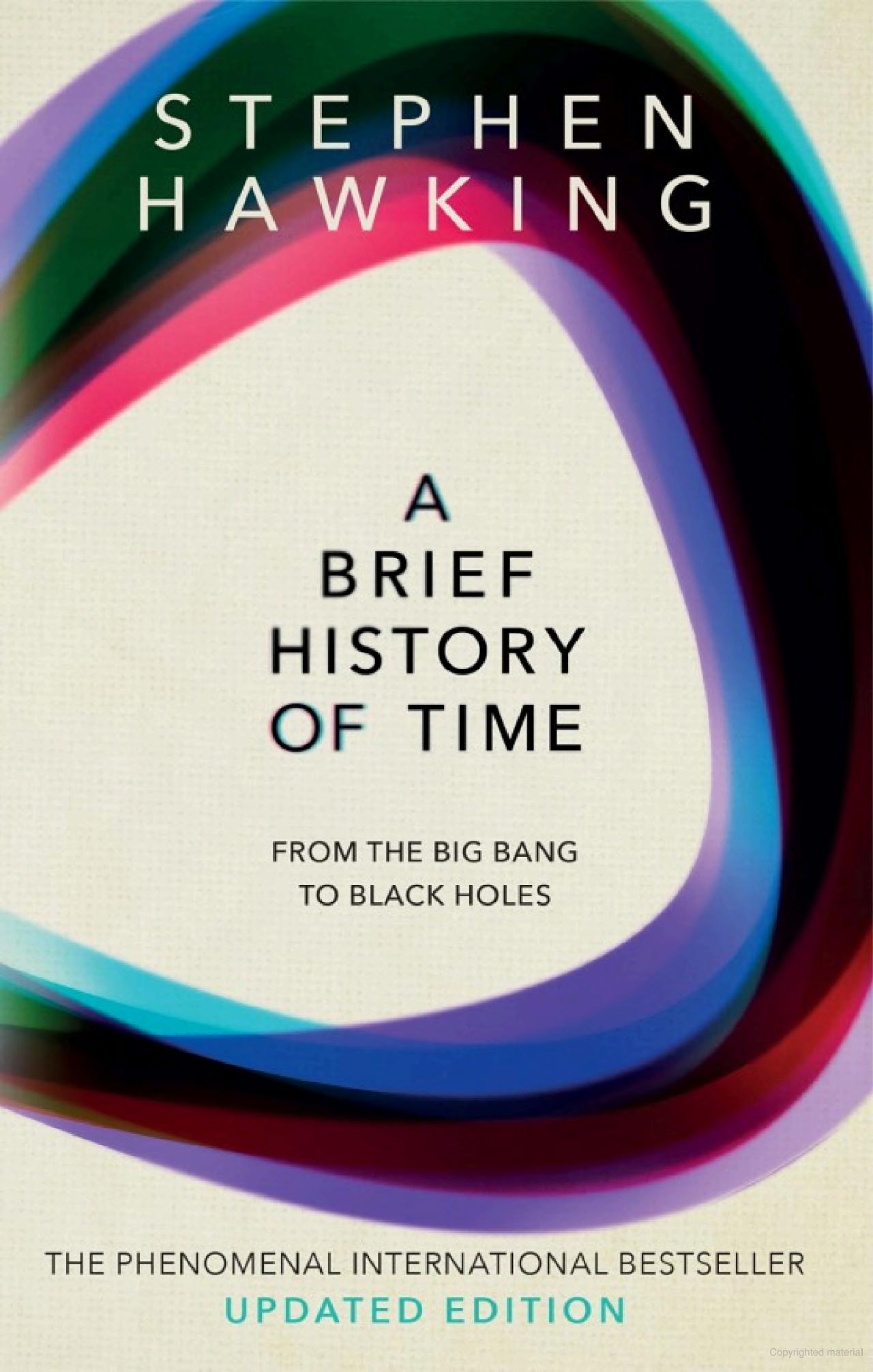
A Brief History of Time
By Stephen Hawking
Book R eview in 500 to 1000 Words eview in 500 to 1000 Words |
A Brief History of Time
By Stephen Hawking
Stephen Hawking’s book A Brief History of Time published in 1988 is aimed at a theoretical audience but has achieved great success in making complex concepts in physics accessible to general readers. The book explores fascinating topics such as the Big Bang, space particle physics, black holes and the fabric of time all presented in a way that a layperson can understand.
This is not just another non-fiction book filled with technical jargon. It simplifies these complex ideas without oversimplifying them making them relatable and easy to grasp. The book takes readers on a journey from the beginning of the universe exploring concepts like the uncertainty principle wormholes the expanding universe and even the concept of time itself.
What I Learned From the Book: The book introduced me to the concept of space and time in a way I had never encountered before. It’s not easy to grasp ideas like the curvature of space black holes or the expanding universe without a fairly deep understanding of physics and math. Yet Hawking’s explanation made these intricate topics more approachable.
The book discusses delicate and mind-bending topics like gravity, light, and the Big Bang. It taught me that the universe is ever-expanding, infinite, and full of mysteries. While some parts of the book are challenging, it is a rewarding read for anyone curious about the universe and its workings.
My Thoughts:
The most complicated topic in the book for me was wormholes. While I know these are theoretical concepts, they made me reflect on the human ability to think beyond our current reality. It’s astonishing to consider how far science has come—from discovering the bulb in 1879 by Thomas Edison to exploring the origins of the universe.
I want to conclude by saying, Nothing is impossible for humans.This book inspires readers to keep questioning and to appreciate the brilliant minds that have shaped our understanding of the world. |
| Book Review in 500 to 1000 Words |
A Brief History of Time
By Stephen Hawking
Stephen Hawking’s book A Brief History of Time published in 1988 is aimed at a theoretical audience but has achieved great success in making complex concepts in physics accessible to general readers. The book explores fascinating topics such as the Big Bang, space particle physics, black holes and the fabric of time all presented in a way that a layperson can understand.
This is not just another non-fiction book filled with technical jargon. It simplifies these complex ideas without oversimplifying them making them relatable and easy to grasp. The book takes readers on a journey from the beginning of the universe exploring concepts like the uncertainty principle wormholes the expanding universe and even the concept of time itself.
What I Learned From the Book: The book introduced me to the concept of space and time in a way I had never encountered before. It’s not easy to grasp ideas like the curvature of space black holes or the expanding universe without a fairly deep understanding of physics and math. Yet Hawking’s explanation made these intricate topics more approachable.
The book discusses delicate and mind-bending topics like gravity, light, and the Big Bang. It taught me that the universe is ever-expanding, infinite, and full of mysteries. While some parts of the book are challenging, it is a rewarding read for anyone curious about the universe and its workings.
My Thoughts:
The most complicated topic in the book for me was wormholes. While I know these are theoretical concepts, they made me reflect on the human ability to think beyond our current reality. It’s astonishing to consider how far science has come—from discovering the bulb in 1879 by Thomas Edison to exploring the origins of the universe.
I want to conclude by saying, Nothing is impossible for humans.This book inspires readers to keep questioning and to appreciate the brilliant minds that have shaped our understanding of the world. |
Original Title
A Brief History of Time
Subject & College
Publish Date
1988-05-05
Published Year
1988
Publisher, Place
Total Pages
256
ISBN
9780553109535
Format
Hardcover
Country
United Kingdom
Language
English
Average Ratings
Readers Feedback
Sapiens : A Brief History of Human Kind
A Brief History of Time By Stephen Hawking Stephen Hawking's book A Brief History of Time published in 1988 is aimed at a theoretical audience...Read More

Gaurav M. Choudhari
Sapiens : A Brief History of Human Kind
A Brief History of Time
By Stephen Hawking
Stephen Hawking’s book A Brief History of Time published in 1988 is aimed at a theoretical audience but has achieved great success in making complex concepts in physics accessible to general readers. The book explores fascinating topics such as the Big Bang, space particle physics, black holes and the fabric of time all presented in a way that a layperson can understand.
This is not just another non-fiction book filled with technical jargon. It simplifies these complex ideas without oversimplifying them making them relatable and easy to grasp. The book takes readers on a journey from the beginning of the universe exploring concepts like the uncertainty principle wormholes the expanding universe and even the concept of time itself.
What I Learned From the Book:
The book introduced me to the concept of space and time in a way I had never encountered before. It’s not easy to grasp ideas like the curvature of space black holes or the expanding universe without a fairly deep understanding of physics and math. Yet Hawking’s explanation made these intricate topics more approachable.
The book discusses delicate and mind-bending topics like gravity, light, and the Big Bang. It taught me that the universe is ever-expanding, infinite, and full of mysteries. While some parts of the book are challenging, it is a rewarding read for anyone curious about the universe and its workings.
My Thoughts:
The most complicated topic in the book for me was wormholes. While I know these are theoretical concepts, they made me reflect on the human ability to think beyond our current reality. It’s astonishing to consider how far science has come—from discovering the bulb in 1879 by Thomas Edison to exploring the origins of the universe.
I want to conclude by saying, Nothing is impossible for humans.This book inspires readers to keep questioning and to appreciate the brilliant minds that have shaped our understanding of the world.
Gaurav M. Choudhari
A Brief History of Time : From Big Bang to Black Holes
Stephen Hawking’s A Brief History of Time is a monumental exploration of the universe, blending complex scientific theories with accessible explanations for a general audience....Read More

MAHEK SIRAJ INAMDAR
A Brief History of Time : From Big Bang to Black Holes
Stephen Hawking’s A Brief History of Time is a monumental exploration of the universe, blending complex scientific theories with accessible explanations for a general audience. Published in 1988, this book introduces readers to some of the most profound questions of existence: What is the nature of time? How did the universe begin? And, where is it heading? Hawking takes us through the history of cosmology, from ancient beliefs to modern advancements, explaining key concepts such as the Big Bang, black holes, and the theory of relativity. With clarity and precision, he simplifies difficult ideas, such as quantum mechanics and the uncertainty principle, while captivating readers with his intellectual curiosity and enthusiasm for discovery. His ability to communicate groundbreaking ideas without relying on heavy mathematical equations ensures that the book remains accessible, though some sections still require careful reading to fully grasp the scientific depth.
One of the central themes of the book is Hawking’s discussion of time and the quest for a unified theory that reconciles general relativity and quantum mechanics. He delves into the mysteries of black holes, explaining how they warp space and time, and introduces the concept of imaginary time, which challenges conventional notions of past and future. Hawking’s reflections extend beyond physics, venturing into philosophical and theological realms as he ponders the role of a creator in the universe’s origins. His famous assertion that understanding a “complete theory” would allow humanity to “know the mind of God” illustrates the profound implications of cosmological research while leaving room for personal interpretation. This balance of science and philosophy is one of the book’s greatest strengths, as it inspires readers to think deeply about the universe and humanity’s place within it.
While the book is a remarkable achievement, some readers may find it challenging due to the inherent complexity of topics like quantum mechanics and string theory. Hawking’s use of metaphors and diagrams helps simplify these ideas, but certain sections demand patience and focus. Despite these challenges, A Brief History of Time remains a cornerstone of popular science writing, celebrated for making advanced physics accessible to millions worldwide. It is not merely a scientific guide but a thought-provoking journey through the cosmos that encourages readers to marvel at the universe’s beauty and intricacy. Whether you are a novice or an enthusiast in science, Hawking’s work is a timeless masterpiece that continues to inspire curiosity and wonder about the mysteries of existence.