
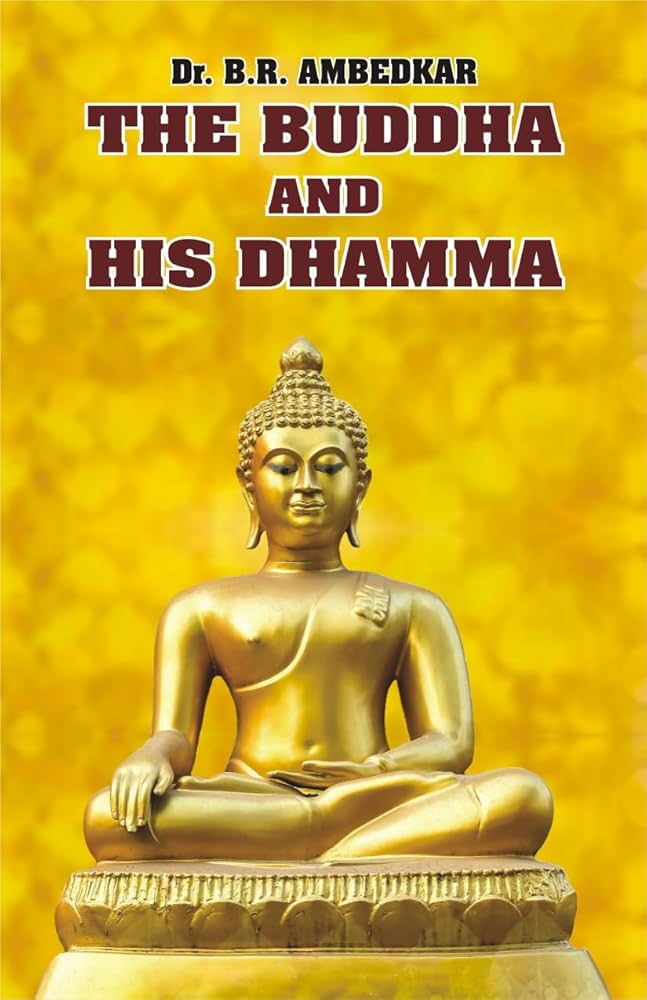
Lord Buddha and His Dhamma
By Dr. B. R. Ambedkar
This book highlights how Buddhism ancient but so moder by comparing ancient Buddhist principles with modern demands of Democratic Polity of Nation. It reveals the speech of Dr. B. R. Ambedkar in the Constituent Assembly which emphasis that why democratic values and principles of our Constitution are not borrowed but based on our own Buddhist Value.
This book highlights how Buddhism ancient but so moder by comparing ancient Buddhist principles with modern demands of Democratic Polity of Nation. It reveals the speech of Dr. B. R. Ambedkar in the Constituent Assembly which emphasis that why democratic values and principles of our Constitution are not borrowed but based on our own Buddhist Value.
Availability
available
Original Title
Lord Buddha and His Dhamma
Subject & College
Series
Publish Date
1957-01-01
Published Year
1957
Publisher, Place
Total Pages
601
ISBN
978-81-7154-300-6
Format
Hard cover, Paper back and E-book
Country
india
Language
English
Average Ratings
Readers Feedback
Lord Buddha and His Dhamma by Dr. Ambedkar
More than just a biography, Lord Buddha and His Dhamma provides a message for both personal and societal development. Buddhism is now comprehensible and relevant...Read More

Dr. Kirankumar Miraji Salve
Lord Buddha and His Dhamma by Dr. Ambedkar
More than just a biography, Lord Buddha and His Dhamma provides a message for both personal and societal development. Buddhism is now comprehensible and relevant to readers in the modern period because of Dr. Ambedkar’s rational and reformist viewpoint.
The book focusses on Buddha’s thought and offers a guide for living a life of equality, compassion, and mindfulness, going beyond simple biography. Dr. Ambedkar frames the teachings of Buddha as a challenge to the repressive systems of his day and highlights their revolutionary and logical features.
This book inspires us to strive for a more compassionate and just society in addition to shaping our understanding of the Buddha’s life and teachings. It is a must-read for everyone.
Dr. Kirankumar Miraji Salve
Buddha and His Dhamma
Nice thoughts , very well Explained about this book......Read More

Maya jitendra kamble
• Dhamma, • Justice • Equality • Liberty • Fraternity • Democracy • Secularism • Socialreform • Rule oflaw
Initial Impression When I first picked up Lord Buddha and His Dhamma by Dr. B. R. Ambedkar, I was drawn by its unique perspective on...Read More

Prof. Dr. Atul Lalasaheb More
• Dhamma, • Justice • Equality • Liberty • Fraternity • Democracy • Secularism • Socialreform • Rule oflaw
Initial Impression
When I first picked up Lord Buddha and His Dhamma by Dr. B. R. Ambedkar, I was drawn by its unique perspective on Buddhism. Written by one of India’s greatest reformers and the architect of the Indian Constitution, this book promised not only to provide insights into the life and teachings of Buddha but also to address socio-political realities through the lens of Buddhist philosophy. Knowing Dr. Ambedkar’s profound influence on the social movement and his role in popularizing Buddhism in modern India, I anticipated an intersection of history, spirituality, and social commentary that would resonate deeply.
Overview
The book is a retelling of the life and teachings of Gautama Buddha, presented in a clear, rational, and thought-provoking manner. Divided into sections, it narrates Buddha’s journey from Prince Siddhartha to the Enlightened One. It explores his decision to renounce worldly pleasures, his quest for truth, the establishment of the Sangha, and his teachings on the Dhamma (path of righteousness).
The book goes beyond mere biography to focus on Buddha’s philosophy, offering a blueprint for a life of compassion, equality, and mindfulness. Unlike traditional hagiographies, Ambedkar emphasizes the rational and revolutionary aspects of Buddha’s teachings, framing them as a challenge to the oppressive structures of his time.
Themes
Dr. B.R. Ambedkar delves into several key themes:
1. Equality and Social Justice: Buddha’s teachings reject the caste system and promote equality among all beings, which aligns with Ambedkar’s lifelong fight against caste oppression.
2. Rationality over Rituals: The book highlights Buddha’s rejection of superstitions and rituals, emphasizing a rational approach to spirituality.
3. Dhamma as a Way of Life: Ambedkar presents Buddhism not as a religion in the traditional sense but as a practical way of living based on morality, reason, and compassion.
4. EmancipationandLiberation:Buddha’steachings areframedas a means for personal and societal liberation, particularly from suffering and social inequality.
Non-violence: Ahimsa (non-violence) is a recurring theme, reinforcing the idea of compassion as a cornerstone of Buddhist philosophy.
Strengths
• Relevance: The book connects ancient teachings with contemporary issues, making it timeless.
• Clarity: Dr. B.R. Ambedkar’slucid writing ensures that complex ideas are easily understood.
• Perspective: The focus on Lord Buddha as a reformer rather than adivine figure adds depth and authenticity.
RationalApproach: The emphasis on reason and practicality sets the book apart from traditional religious texts.
Weaknesses
• Repetitiveness: Some arguments are repeated, which might feel redundant to readers familiar with Dr. B. R. Ambedkar’s otherworks.
Bias: Dr. B. R. Ambedkar’s critique of Brahminism is sharp, and while justified, it may come across as one-sided to some readers.
Conclusion
Lord Buddha and His Dhamma is more than a biography; it is a manifesto for personal and societal transformation. Dr. Ambedkar’s rational and reformist interpretation of Buddhism makes it accessible and relevant to modern readers. The book not only depends our understanding of Buddha’s life and teachings but also inspires us to strive for a more just and compassionate world. It is a must-read for anyone interested in spirituality, history, or social reform.