
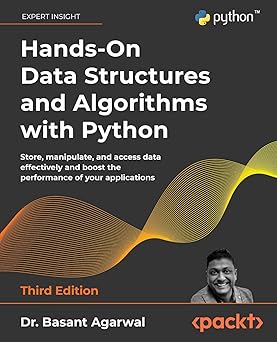
Hands -on Data Structures and Algorithms with Python Hands -on Data Structures and Algorithms with Python
By Basant Agarwal and Benjamin Baka

Original Title
Hands -on Data Structures and Algorithms with Python Hands -on Data Structures and Algorithms with Python
Subject & College
Language
English
Readers Feedback
Title of Book: Hands -on Data Structures and Algorithms with Python Hands -on Data Structures and Algorithms with Python
• • Author: Dr. Basant Agarwal and Benjamin Baka • Publication: SPD Shroff Publishers & Distributors PVT. LTD • Name of the Book Reviewer: Mahajan,...Read More

Pratibha College of Commerce and Computer Studies,Prof Dipali Mahajan
Title of Book: Hands -on Data Structures and Algorithms with Python Hands -on Data Structures and Algorithms with Python
•
• Author: Dr. Basant Agarwal and Benjamin Baka
• Publication: SPD Shroff Publishers & Distributors PVT. LTD
• Name of the Book Reviewer: Mahajan, Dipali
About Book Content:
This book is very helpful for anyone who wants to clearly understand data structures and algorithms using Python. It starts with the basics, such as linked lists, doubly linked lists, and circular linked lists, and explains them in an easy and understandable way. The concepts are explained step by step, which makes learning comfortable even for beginners.
As you progress through the chapters, the book introduces more advanced data structures like stacks, queues, graphs, and trees. Topics such as binary search and binary search trees are explained using simple examples and diagrams, which makes complex ideas easier to grasp. The explanations focus not only on theory but also on how and where these algorithms are used in real programming tasks.
The book also covers important sorting algorithms like bubble sort, selection sort, insertion sort, and merge sort in detail. Each algorithm is explained clearly with Python implementations, helping readers understand how the logic works in actual code.
One of the best aspects of this book is its focus on writing clean, well-organized, and reusable code. By the end of the book, readers will be able to design programs that are easy to understand, debug, and extend. Overall, this book is an excellent resource for students, beginners, and anyone interested in strengthening their foundation in Python data structures and algorithms.