
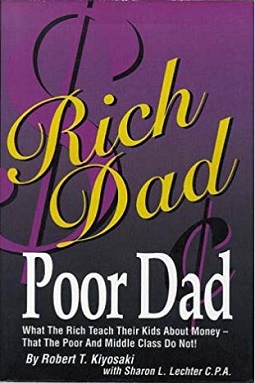
Rich Dad Poor Dad
By Robert T Kiyosaki
The story begins with the author as a young boy, observing the contrasting financial mindsets and behaviors of his own father, the “poor dad,” and a friend’s father, the “rich dad.” The poor dad held a high position in education and emphasized the importance of academic success, job security, and living within one’s means. The rich dad, a successful entrepreneur, believed in building assets, investing wisely, and acquiring financial knowledge. It describes how the rich dad teaches the author and his friend finance through practical lessons.
The story begins with the author as a young boy, observing the contrasting financial mindsets and behaviors of his own father, the “poor dad,” and a friend’s father, the “rich dad.” The poor dad held a high position in education and emphasized the importance of academic success, job security, and living within one’s means. The rich dad, a successful entrepreneur, believed in building assets, investing wisely, and acquiring financial knowledge. It describes how the rich dad teaches the author and his friend finance through practical lessons.
Availability
available
Subject & College
Publish Date
2000-04-28
Published Year
2000
Publisher, Place
Total Pages
336
ISBN 13
0-446-67745-0
Format
Hardcover
Country
USA
Language
English
Average Ratings
Readers Feedback
Personal finance book that contrasts two approaches to money and wealth-building.
“Rich Dad Poor Dad” is a personal finance and self-help book that has inspired millions of readers globally. Originally published in 1997, the book presents...Read More

Uzera Mehboob Khan (IInd Year B.A.-LL.B.)
Personal finance book that contrasts two approaches to money and wealth-building.
“Rich Dad Poor Dad” is a personal finance and self-help book that has inspired millions of readers globally. Originally published in 1997, the book presents a narrative where Kiyosaki contrasts the financial philosophies of two father figures: his biological father (the “Poor Dad”) and the father of his best friend Mike (the “Rich Dad”). Through this comparison, Kiyosaki explores key principles of financial independence, wealth-building, and mindset shifts that can transform one’s approach to money.
The central theme of Rich Dad Poor Dad is the importance of financial education and the idea that conventional wisdom regarding work and money is flawed. Kiyosaki argues that schools focus too much on academic education, preparing students to become employees rather than teaching them about financial management and wealth creation. According to Kiyosaki, the poor
and middle class tend to work for money, while the rich make money work for them.
Kiyosaki presents these lessons through anecdotes and real-life experiences from his life. He describes how his “Poor Dad” was well-educated, held a stable government job, and believed in working hard to earn a salary and save money. In contrast, his “Rich Dad” was less formally educated but understood the importance of investing in assets that generate income, and he built
his wealth through entrepreneurship and smart investing.
One of the foundational principles in Rich Dad Poor Dad is the concept of assets versus liabilities. Kiyosaki defines assets as things that put money into your pocket, such as investments, real estate, or businesses that generate passive income. Liabilities, on the other hand, are items that take money out of your pocket, like loans, credit card debt, and consumer goods that depreciate in value. Kiyosaki emphasizes the importance of accumulating assets and minimizing liabilities as a pathway to financial freedom.
Another major takeaway from the book is the idea of financial independence through entrepreneurship. Kiyosaki stresses that the wealthy often create multiple streams of income through businesses, real estate, or investments, rather than relying solely on a paycheck from a job. He advocates for a shift in mindset, encouraging readers to think like investors and entrepreneurs, taking calculated risks to build wealth rather than settling for a secure, but often limiting, career.
Furthermore, Kiyosaki emphasizes the importance of developing financial literacy—knowing how money works, understanding accounting, and being comfortable with investments. He believes that the ability to read and understand financial statements is crucial to making informed decisions and taking control of one’s financial future.
The book also explores the psychological and cultural factors that shape our attitudes towards money. Kiyosaki argues that many people are conditioned to believe in traditional notions of job security, retirement plans, and saving money in a bank. This mindset, he contends, holds people back from achieving financial success. In contrast, the wealthy view money as a tool to generate more wealth, and they continuously seek opportunities for growth and improvement.
One of the most profound aspects of the book is Kiyosaki’s emphasis on the importance of taking risks and learning from failures. He believes that risk-taking and financial experimentation are essential for growth, and that failure should be viewed not as a setback, but as a learning experience. This mindset shift from fear to opportunity is central to Kiyosaki’s philosophy.
“Rich Dad Poor Dad” serves as a call to action for individuals to take control of their financial futures, educate themselves about money, and adopt a mindset of abundance and opportunity. Whether one agrees with every idea presented or not, the book undeniably challenges traditional thinking about money and offers a fresh perspective on achieving financial freedom. For those looking to break free from the rat race and achieve financial independence, Kiyosaki’s insights provide valuable food for thought.
Uzera Mehboob Khan (IInd Year B.A.-LL.B.)
Money, work and Wealth
About the Author Robert Kiyosaki is an entrepreneur, investor, and motivational speaker known for his expertise in personal finance and wealth-building. Through his books and...Read More

Potghan Gauri Karbhari
Money, work and Wealth
About the Author
Robert Kiyosaki is an entrepreneur, investor, and motivational speaker
known for his expertise in personal finance and wealth-building.
Through his books and seminars, he has educated millions worldwide on
financial literacy and the importance of entrepreneurship.
About the Book
Rich Dad Poor Dad is a personal finance classic that challenges
conventional views on money, work, and wealth creation. Kiyosaki
contrasts the financial philosophies of two influential figures in his
life—his biological father (Poor Dad) and the father of his best friend
(Rich Dad).
About the Plot
The book narrates lessons learned from two contrasting approaches to
money management. Poor Dad emphasizes traditional education and
job security, while Rich Dad advocates financial independence
through investments, entrepreneurship, and understanding money as a
tool. Kiyosaki uses anecdotes and practical advice to highlight the
differences in mindset that determine financial success.
About the Characterisation.
The Rich Dad and Poor Dad figures symbolize two distinct
worldviews. Poor Dad represents the conventional approach of
working for money, while Rich Dad embodies a progressive mindset of
making money work for you. Kiyosaki’s narrative captures the wisdom
and flaws of both, making the concepts relatable.
About the Themes
Key themes include financial education, the difference between assets
and liabilities, the importance of passive income, and breaking free from
the rat race. The book emphasizes mindset shifts necessary for
building wealth and highlights the need for continuous learning and
calculated risk-taking.
About Overall Analysis
Rich Dad Poor Dad is an eye-opening guide for readers new to financial
literacy. Its conversational tone and relatable examples make it
accessible, while its focus on mindset over technical jargon sets it apart.
However, the advice often lacks specificity, which might require
supplemental resources for practical application.
Your Opinion
I found Rich Dad Poor Dad to be highly inspiring, particularly in its
emphasis on thinking differently about money. The lessons on assets,
liabilities, and financial independence are transformative for anyone
seeking long-term financial security.
Compare with Similar Works
Compared to books like The Intelligent Investor by Benjamin Graham,
which delves into investment strategies, Rich Dad Poor Dad focuses
more on mindset and foundational financial principles. While Graham’s
work is for advanced readers, Kiyosaki’s is suitable for beginners.
Appreciation/Critique
The book deserves appreciation for its simplicity and motivational tone.
However, some of its advice, such as encouraging entrepreneurship
without delving into potential risks, may seem overly idealistic.
Additionally, critics argue that it sometimes oversimplifies financial
challenges.
Potghan Gauri Karbhari
Growing up with Two dads
About the Author Robert Kiyosaki is an entrepreneur, investor, and motivational speaker known for his expertise in personal finance and wealth-building. Through his books and...Read More
Potghan Gauri Karbhari
Growing up with Two dads
About the Author
Robert Kiyosaki is an entrepreneur, investor, and motivational speaker
known for his expertise in personal finance and wealth-building.
Through his books and seminars, he has educated millions worldwide on
financial literacy and the importance of entrepreneurship.
About the Book
Rich Dad Poor Dad is a personal finance classic that challenges
conventional views on money, work, and wealth creation. Kiyosaki
contrasts the financial philosophies of two influential figures in his
life—his biological father ("Poor Dad") and the father of his best friend
("Rich Dad").
About the Plot
The book narrates lessons learned from two contrasting approaches to
money management. "Poor Dad" emphasizes traditional education and
job security, while "Rich Dad" advocates financial independence
through investments, entrepreneurship, and understanding money as a
tool. Kiyosaki uses anecdotes and practical advice to highlight the
differences in mindset that determine financial success.
About the Characterisation.
The "Rich Dad" and "Poor Dad" figures symbolize two distinct
worldviews. "Poor Dad" represents the conventional approach of
working for money, while "Rich Dad" embodies a progressive mindset of
making money work for you. Kiyosaki’s narrative captures the wisdom
and flaws of both, making the concepts relatable.
About the Themes
Key themes include financial education, the difference between assets
and liabilities, the importance of passive income, and breaking free from
the "rat race." The book emphasizes mindset shifts necessary for
building wealth and highlights the need for continuous learning and
calculated risk-taking.
About Overall Analysis
Rich Dad Poor Dad is an eye-opening guide for readers new to financial
literacy. Its conversational tone and relatable examples make it
accessible, while its focus on mindset over technical jargon sets it apart.
However, the advice often lacks specificity, which might require
supplemental resources for practical application.
Your Opinion
I found Rich Dad Poor Dad to be highly inspiring, particularly in its
emphasis on thinking differently about money. The lessons on assets,
liabilities, and financial independence are transformative for anyone
seeking long-term financial security.
Compare with Similar Works
Compared to books like The Intelligent Investor by Benjamin Graham,
which delves into investment strategies, Rich Dad Poor Dad focuses
more on mindset and foundational financial principles. While Graham’s
work is for advanced readers, Kiyosaki’s is suitable for beginners.
Appreciation/Critique
The book deserves appreciation for its simplicity and motivational tone.
However, some of its advice, such as encouraging entrepreneurship
without delving into potential risks, may seem overly idealistic.
Additionally, critics argue that it sometimes oversimplifies financial
challenges.
Potghan Gauri Karbhari
RICH DAD POOR DAD
“What the rich teach their kids about money that the poor and middle class do not.” Rich dad Poor dad by Robert T. Kiyosaki is...Read More

Ammit S. Gangawane
RICH DAD POOR DAD
“What the rich teach their kids about money that the poor and middle class do not.”
Rich dad Poor dad by Robert T. Kiyosaki is a personal finance book that highlights lesson about money, investing, financial instruments and how to achieve financial independence. Basically in the book he has talked about 2 fathers that is first his biological father who is highly educated, works at job but is poor & in second case his friend’s father, who has formal education and is an entrepreneur who is rich.
There are various lessons which are mentioned in this book which I highlighted as below-
1) The rich do not work for money-
Generally rich people create system in which money comes in their pocket as it creates passive income for them.
2) Assets versus Liabilities-
In second chapter he talks about rich make asset and poor people buy liabilities. Asset is basically what puts money inside your pocket & liabilities take money from pocket.
3) History of taxes and power of corporation-
If you work for money, you give the power to employer. If money works for you, you keep the power to yourself and control it.
One should understand the history of taxes, accounting, investing, markets, and the law, protection of law suits as rich people pay zero taxes and middle poor people are always paying taxes.
4) Work to learn and do not work only for money-
“Job security meant everything to my poor dad while learning meant everything to my rich dad.”
Now a day’s people do not want to learn as they think when schooling, college ends learning stops but that’s not true, learning is continuous process. It never stops. So never stop learning.
Ammit S. Gangawane
Rich dad poor dad
Yash Sandip Deo, Computer science, Third Year, Sinhgad Academy of Engineering kondhwa bk. Pune Rich Dad Poor Dad: A Review Robert Kiyosaki's "Rich Dad Poor...Read More

Yash Sandip Deo
Rich dad poor dad
Yash Sandip Deo, Computer science, Third Year, Sinhgad Academy of Engineering kondhwa bk. Pune
Rich Dad Poor Dad: A Review
Robert Kiyosaki’s “Rich Dad Poor Dad” is not your typical finance book. It’s a personal finance parable that challenges conventional wisdom about money, work, and investing. Through contrasting the financial philosophies of his “rich dad” (a successful businessman) and his “poor dad” (his highly educated but financially struggling schoolteacher father), author introduces readers to key concepts that can empower them to build wealth.
Key Takeaways:
• Financial Literacy is Crucial: The book emphasizes the importance of understanding financial concepts like assets, liabilities, income, and expenses. It argues that schools primarily focus on preparing students to become good employees rather than financially independent individuals.
• The Difference Between Assets and Liabilities:Author defines assets as anything that puts money in your pocket, while liabilities take money out of your pocket. This distinction is fundamental to building wealth.
• Building Cash Flow: The book stresses the importance of generating income from assets, not just relying on earned income (salary). It encourages readers to acquire income-producing assets like real estate, businesses, and stocks.
• Mindset is Key: “Rich Dad Poor Dad” highlights the significance of mindset and beliefs about money. It argues that negative beliefs about money can hinder financial success.
• The Importance of Taking Risks: The book encourages readers to step outside their comfort zones and take calculated risks in their financial endeavors. It acknowledges that failure is an inevitable part of the learning process.
• The Power of Financial Education:Author advocates for continuous learning and self-education in personal finance. He emphasizes the importance of seeking knowledge and mentorship from successful investors.
Strengths:
• Easy to Read and Understand: Written in a conversational and engaging style, “Rich Dad Poor Dad” is accessible to readers with varying levels of financial knowledge.
• Challenging Conventional Wisdom: The book challenges many of the traditional views on money and work, prompting readers to question their own beliefs and assumptions.
• Focus on Practical Application:Author provides practical advice and actionable steps that readers can take to improve their financial situation.
• Inspiring and Motivational: The book can be a powerful motivator for those seeking to improve their financial lives and achieve financial freedom.
Weaknesses:
• Oversimplification: Some critics argue that the book oversimplifies complex financial concepts and may not be suitable for everyone.
• Focus on Real Estate: The book heavily emphasizes real estate investing, which may not be the most suitable investment strategy for all individuals or in all economic conditions.
Overall:
“Rich Dad Poor Dad” is a thought-provoking and influential book that has helped millions of people re-evaluate their relationship with money. While it may not be a comprehensive guide to investing, it serves as a valuable starting point for anyone seeking to improve their financial literacy and build wealth. The book’s emphasis on mindset, financial education, and the importance of taking calculated risks resonates with many readers and can be a powerful motivator for personal financial growth.
Disclaimer/Conclusion: This review provides a general overview of the book. It is essential to conduct through research and consider your own individual circumstances before making any financial decisions.
I say from my personal experience that everyone should read this book at least once, I hope this review is helpful!
Yash Sandip Deo
Inspirational Book
Rich Dad Poor Dad is among the most influential books in personal finance, written by Robert T. Kiyosaki and published in 1997. It combines storytelling...Read More

Shravani Talwar
Inspirational Book
Rich Dad Poor Dad is among the most influential books in personal finance, written by Robert T. Kiyosaki and published in 1997. It combines storytelling with financial principles, challenging traditional beliefs about money and
wealth. The book contrasts the philosophies of two key figures in Kiyosaki’s life: his biological father, the “Poor Dad,” and the father of his best friend, the “Rich Dad”. These opposing perspectives provide readers with valuable insights into achieving financial independence and escaping the rat race.