
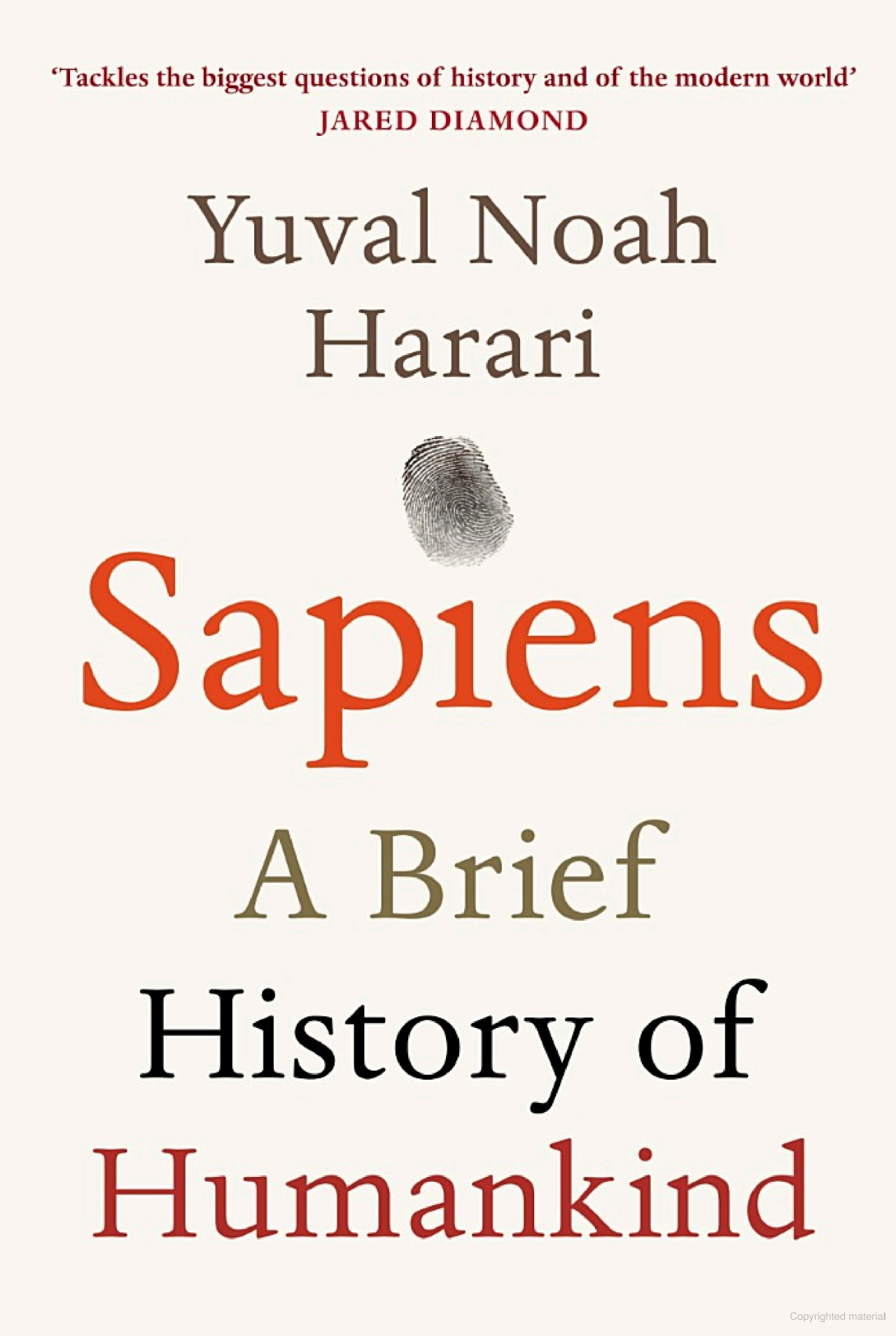
Sapiens : A Brief History of Human Kind
By Yuval Noah Harari
| Book Review: Sapiens: A Brief History of Humankind By Yuval Noah Harari
1. Introduction: Yuval Noah Harari’s book, Sapiens: A Brief History of Humankind published in 2011, is a must-read for all humans, regardless of their discipline, whether biologists, physicists, or historians. In today’s world, We, Homo sapiens, are often ready to harm other sapiens because we don’t see ourselves as the same. Instead, we define ourselves by our religion, nationality, and identity, and dismiss those who are ‘different’. We convince ourselves that their problems and suffering are not ours, and in times of conflict, we feel justified in causing harm, as they are not us. In such a situation, this book becomes highly relevant, as it narrates the evolution of Homo sapiens and explains how only Homo sapiens, the modern humans survived among at least six species of humans, So, we are all the same; we have only Earth to survive, so we must unite. 2. Summary of the Book: The first chapter of this book begins with the Cognitive Revolution. Harari explains how environmental and biological changes led to the Cognitive Revolution in Homo sapiens around 70,000 years ago. He describes how the development of a sophisticated language allowed for the creation of fictional stories, which helped form larger human groups. This ability to cooperate in large groups made Homo sapiens exceptionally powerful, marking the first significant step from animals to humans. In the second chapter, Harari discusses the Agricultural Revolution, which occurred around 12,000 years ago. This revolution led to the domestication of plants and animals and resulted in a significant loss of biodiversity. Interestingly, Harari argues that humans did not domesticate plants and animals; instead, plants and animals domesticated humans. Early humans, who once consumed a wide variety of foods, became dependent on just a few crops and livestock. These species, which would have struggled to survive in the wild, thrived as humans provided them with shelter, protection, and sustenance. Additionally, farming created social hierarchies, increased inequality, and led to the exploitation of both humans and the environment. Despite its drawbacks, the Agricultural Revolution set the stage for the rise of civilizations and the world as we know it today. In the third chapter, Harari introduces the roles of money, empire, and religion in shaping human societies. He argues that shared myths and narratives helped form common beliefs and moral frameworks, leading to the emergence of religion. These larger shared beliefs laid the foundation for the innovation of money, which enabled economic cooperation among diverse communities. The combination of shared beliefs, money, morals, and laws facilitated collaboration and sometime conflict with neighboring societies, ultimately leading to the formation of empires. Harari emphasizes that these systems—money, religion, and empires—became pillars of human civilization but also created hierarchies. Some groups gained power and privilege, while others were relegated to inferior positions. This marked the beginning of exploitation and the early roots of capitalism. In the fourth chapter, Harari explains how humans transitioned from being mere animals to assuming God-like powers through the Scientific Revolution, which began 500 years ago. He argues that capitalism and the desire for expanding empires fueled this revolution. At its onset, the Scientific Revolution broke down barriers created by traditional fictional stories and paved the way for groundbreaking discoveries. This revolution brought significant benefits to humanity, such as increased life expectancy through medical innovations and liberation from generational exploitation perpetuated by myths and fictional narratives. However, scientific progress did not stop at improving human life and creating a better society. It continued to push boundaries, aiming to conquer death and even threatening the world with destruction through the creation of nuclear weapons. Humans have gone beyond Earth, reaching the Moon and Mars, and have even created cloned copies of themselves in the form of robots and artificial intelligence. Harari provocatively suggests that this relentless pursuit of advancement marks the potential end of Homo sapiens, as artificial intelligence may emerge as the new dominant “species. 3. Critical Analysis: Although Harari’s Sapiens is a thought-provoking book, it overlooks the contributions of the East to scientific advancements that predate the Scientific Revolution in the West. Many ideas and arguments in the book are oversimplified and lack sufficient factual backing, such as the assertion that plants domesticated humans. Additionally, while Harari acknowledges the usefulness of artificial intelligence, his critical stance on its potential to destroy human civilization comes across as speculative and lacks concrete evidence to support such a sweeping claim. 4. Conclusion This is a remarkable book with the power to change the way you see the world. The arguments Harari presents are factual, logical, and thought-provoking, compelling readers to deeply reflect on them. His approach reminds us that Homo sapiens are the only surviving species of the genus and that all divisions beyond biology are mere fiction. Harari’s message urges us to unite, work together to eliminate suffering, and protect our only home-our “Mother Earth”.
5. Rating: I would rate 5/5, As it is a wonderful must-read book for all. |
| Book Review: Sapiens: A Brief History of Humankind By Yuval Noah Harari
1. Introduction: Yuval Noah Harari’s book, Sapiens: A Brief History of Humankind published in 2011, is a must-read for all humans, regardless of their discipline, whether biologists, physicists, or historians. In today’s world, We, Homo sapiens, are often ready to harm other sapiens because we don’t see ourselves as the same. Instead, we define ourselves by our religion, nationality, and identity, and dismiss those who are ‘different’. We convince ourselves that their problems and suffering are not ours, and in times of conflict, we feel justified in causing harm, as they are not us. In such a situation, this book becomes highly relevant, as it narrates the evolution of Homo sapiens and explains how only Homo sapiens, the modern humans survived among at least six species of humans, So, we are all the same; we have only Earth to survive, so we must unite. 2. Summary of the Book: The first chapter of this book begins with the Cognitive Revolution. Harari explains how environmental and biological changes led to the Cognitive Revolution in Homo sapiens around 70,000 years ago. He describes how the development of a sophisticated language allowed for the creation of fictional stories, which helped form larger human groups. This ability to cooperate in large groups made Homo sapiens exceptionally powerful, marking the first significant step from animals to humans. In the second chapter, Harari discusses the Agricultural Revolution, which occurred around 12,000 years ago. This revolution led to the domestication of plants and animals and resulted in a significant loss of biodiversity. Interestingly, Harari argues that humans did not domesticate plants and animals; instead, plants and animals domesticated humans. Early humans, who once consumed a wide variety of foods, became dependent on just a few crops and livestock. These species, which would have struggled to survive in the wild, thrived as humans provided them with shelter, protection, and sustenance. Additionally, farming created social hierarchies, increased inequality, and led to the exploitation of both humans and the environment. Despite its drawbacks, the Agricultural Revolution set the stage for the rise of civilizations and the world as we know it today. In the third chapter, Harari introduces the roles of money, empire, and religion in shaping human societies. He argues that shared myths and narratives helped form common beliefs and moral frameworks, leading to the emergence of religion. These larger shared beliefs laid the foundation for the innovation of money, which enabled economic cooperation among diverse communities. The combination of shared beliefs, money, morals, and laws facilitated collaboration and sometime conflict with neighboring societies, ultimately leading to the formation of empires. Harari emphasizes that these systems—money, religion, and empires—became pillars of human civilization but also created hierarchies. Some groups gained power and privilege, while others were relegated to inferior positions. This marked the beginning of exploitation and the early roots of capitalism. In the fourth chapter, Harari explains how humans transitioned from being mere animals to assuming God-like powers through the Scientific Revolution, which began 500 years ago. He argues that capitalism and the desire for expanding empires fueled this revolution. At its onset, the Scientific Revolution broke down barriers created by traditional fictional stories and paved the way for groundbreaking discoveries. This revolution brought significant benefits to humanity, such as increased life expectancy through medical innovations and liberation from generational exploitation perpetuated by myths and fictional narratives. However, scientific progress did not stop at improving human life and creating a better society. It continued to push boundaries, aiming to conquer death and even threatening the world with destruction through the creation of nuclear weapons. Humans have gone beyond Earth, reaching the Moon and Mars, and have even created cloned copies of themselves in the form of robots and artificial intelligence. Harari provocatively suggests that this relentless pursuit of advancement marks the potential end of Homo sapiens, as artificial intelligence may emerge as the new dominant “species. 3. Critical Analysis: Although Harari’s Sapiens is a thought-provoking book, it overlooks the contributions of the East to scientific advancements that predate the Scientific Revolution in the West. Many ideas and arguments in the book are oversimplified and lack sufficient factual backing, such as the assertion that plants domesticated humans. Additionally, while Harari acknowledges the usefulness of artificial intelligence, his critical stance on its potential to destroy human civilization comes across as speculative and lacks concrete evidence to support such a sweeping claim. 4. Conclusion This is a remarkable book with the power to change the way you see the world. The arguments Harari presents are factual, logical, and thought-provoking, compelling readers to deeply reflect on them. His approach reminds us that Homo sapiens are the only surviving species of the genus and that all divisions beyond biology are mere fiction. Harari’s message urges us to unite, work together to eliminate suffering, and protect our only home-our “Mother Earth”.
5. Rating: I would rate 5/5, As it is a wonderful must-read book for all. |
Original Title
Sapiens : A Brief History of Human Kind
Subject & College
Series
Publish Date
2011-01-01
Published Year
2011
Publisher, Place
Total Pages
464
ISBN
9780062316097
Format
Hardcover
Country
Israel
Language
English
Average Ratings
Readers Feedback
Unraveling Humanity: A Captivating Journey Through Sapiens
Chavan Ved Vithoba (STUDENT) B.Y.K.College of Commerce NASHIK. Yuval Noah Harari’s Sapiens: A Brief History of Humankind is a masterful and thought-provoking examination of the...Read More

Chavan Ved Vithoba
Unraveling Humanity: A Captivating Journey Through Sapiens
Chavan Ved Vithoba (STUDENT)
B.Y.K.College of Commerce NASHIK.
Yuval Noah Harari’s Sapiens: A Brief History of Humankind is a masterful and thought-provoking
examination of the history of the human species, charting our journey from the earliest days of Homo
sapiens to the complexities of modern society. Published in 2014, the book combines insights from
biology, anthropology, history, and philosophy to offer a sweeping and accessible narrative of
humanity’s evolution and its profound impact on the world.
The book begins by delving into the cognitive revolution, which occurred approximately 70,000
years ago. Harari argues that this transformative shift in our ancestors' ability to communicate and think
abstractly enabled Homo sapiens to dominate the planet. Unlike other species, humans developed the
capacity to imagine and share complex ideas, which fostered large-scale cooperation and societal
structures. Harari places significant emphasis on the role of shared myths—religions, ideologies, and
societal constructs—in binding humans together. He contends that our ability to believe in collective
fictions is one of the most significant factors that have shaped human civilizations, allowing for
unparalleled growth and adaptability.
The second section of the book examines the agricultural revolution, which began approximately
12,000 years ago. Harari challenges the conventional view of agriculture as a purely positive
development, arguing that while it facilitated population growth and the rise of complex civilizations, it
also introduced profound social and environmental consequences. The shift from foraging to farming led
to the establishment of social hierarchies, economic inequality, and the exploitation of labor. Harari
critiques the notion that this transition necessarily improved the quality of life for individuals, suggesting
instead that it often resulted in a more regimented and less fulfilling existence for the majority of
people. This critical perspective invites readers to reconsider the long-term impact of one of humanity’s
most significant turning points.
The book’s third section explores the unification of humankind through the rise of empires, trade
networks, and religions. Harari highlights how these forces have created interconnected global systems,
facilitating cooperation on a massive scale. He examines the role of shared ideologies, such as
capitalism, nationalism, and humanism, in shaping societies and enabling large-scale collaboration.
Harari’s analysis underscores the dual nature of these shared beliefs: while they have driven progress
and innovation, they have also been sources of conflict and exploitation. This section provides valuable
insight into the ways in which cultural, political, and economic forces have shaped human history and
continue to influence global dynamics today.
The final section of Sapiens focuses on the scientific revolution, which began approximately 500
years ago, and its transformative impact on humanity. Harari traces the rapid advancements in science
and technology, from the industrial revolution to the development of artificial intelligence and genetic
engineering. He examines the ways in which humans have harnessed scientific knowledge to transcend
biological limitations, raising critical ethical questions about the future of humanity. Harari speculates on
the potential creation of "superhumans" and the implications of biotechnology and artificial intelligence,
cautioning against the unexamined consequences of these advancements. His exploration of the
interplay between scientific progress and human values challenges readers to reflect on the potential
trajectories of our species.
Harari’s writing is engaging and accessible, making complex ideas understandable without
oversimplifying them. His interdisciplinary approach—blending history, biology, and philosophy—offers
a comprehensive and ambitious perspective on human history. The narrative is enriched by Harari’s
ability to connect disparate themes, creating a cohesive and thought-provoking analysis of humanity’s
past, present, and future.
However, Sapiens is not without its critiques. Some scholars argue that Harari’s broad scope
occasionally leads to oversimplification of complex topics. Additionally, his conclusions about human
nature and progress can feel overly deterministic at times, leaving little room for alternative
interpretations. Despite these criticisms, the book’s strengths far outweigh its limitations. Harari’s
willingness to tackle expansive questions and challenge conventional narratives makes Sapiens a
valuable contribution to the field of popular science and history.
Overall, Sapiens: A Brief History of Humankind is a captivating and intellectually stimulating
work that invites readers to critically examine humanity’s journey and its implications for the future.
Harari’s insights challenge conventional ideas about human history and encourage reflection on the
broader forces that have shaped our species. For anyone seeking a deeper understanding of the human
condition, Sapiens offers a compelling narrative that is as enlightening as it is thought-provoking.
Chavan Swapnil Chadrakant
संगमनेर नगरपालिका कला. दा.ज. मालपाणी वाणिज्य आणि ब. ना. सारडा विज्ञान महाविद्यालय (स्वायत्त), संगमनेर जि. अहमदनगर विद्यार्थी: चव्हाण स्वप्निल चंद्रकांत वर्ग: एम.ए. पुस्तकाचे नाव -...Read More

Vishal Jadhav
Chavan Swapnil Chadrakant
संगमनेर नगरपालिका कला. दा.ज. मालपाणी वाणिज्य आणि ब. ना. सारडा विज्ञान महाविद्यालय (स्वायत्त), संगमनेर जि. अहमदनगर
विद्यार्थी: चव्हाण स्वप्निल चंद्रकांत
वर्ग: एम.ए.
पुस्तकाचे नाव – सेपियन्स – मानवी उत्क्रांतीचा इतिहास
लेखकाचे नाव – युहल नोट हरारी
पुस्तक परीक्षण/पुस्तक अभिप्राय
होमो सेपियन्स हे युहल नोट हरारी यांचे लिहीलेले एक अतिशय प्रभावशाली आणि विचारप्रवर्तक पुस्तक आहे. ते मानवजातीच्या उत्क्रांतीचा एक व्यापक इतिहास सांगते परंतु हा इतिहास फक्त जैविक दृष्टीकोनातून नव्हे तर सामाजिक, सांस्कृतिक आणि मानसिक दृष्टीकोनातूनही सांगितला आहे. हरारी यांनी मानवजातीच्या इतिहासाला तीन प्रमुख क्रांतीमध्ये विभागले आहे.
संज्ञानात्मक क्रांती : या काळात, सुमारे 70000 वर्षापूर्वी, होमो सेपियन्सने अचानक आषा, कल्पना आणि सांकेतिक विचारांचा विकास केला. यामुळे त्यांना मोठ्या गटांमध्ये सहकार्य करण्याची आणि जटिल सामाजिक संरचना तयार करण्याची क्षमता मिळाली.
कृषी क्रांती : सुमारे 12000 वर्षांपूर्वी, मानवांनी शिकारी जीवनशैली सोडून शेती करण्यास सुरुवात केली. यामुळे लोकसंख्येची वाढ झाली आणि शहरे निर्माण झाली, परंतु त्याच वेळी अनेक समस्या देखील निर्माण झाल्या जसे की गरीबी , रोग आणि सामाजिक असमानता.
वैज्ञानिक क्रांती: सुमारे 300 वर्षांपूर्वी सुरु झालेली ही क्रांती, विज्ञानाच्या आणि तंत्रज्ञानाच्या साहाय्याने मानवाला अतुलनीय शक्ति प्रदान करते. यामुळे मानवाला रोगांवर मात करण्यास, भूक दूर करण्यास आणि जगण्याची गुणवत्ता सुधारण्यास मदत झाली आहे. परंतु यामुळे पर्यावरणीय समस्या आणि नैतिक प्रश्न देखील निर्माण झाले आहेत.
हरारी यांनी या पुस्तकात कल्पनांच्या महत्त्वावर विशेष भर दिला आहे. त्यांच्या मते , मानवजातीने इतर प्राण्यांपेक्षा वेगळे कार्य केले आहे ते म्हणजे आपण कल्पनाच्या जगात राहतो. आपण देव, पैसा, राष्ट्रवाद, मानव अधिकार यांसारख्या काल्पनिक संकल्पनांवर विश्वास ठेवतो आणि त्यांच्यावर आधारित समाज तयार करतो.या कल्पनांमुळे आपण मोठ्या प्रमाणात सहकार्य करू शकतो, आणि जटिल सामाजिक संरचना तयार करू शकतो .
‘सेपियन्स’ हे एक विचारप्रवर्तक पुस्तक आहे जे आपल्याला मानवजातीच्या भूतकाळ, वर्तमान आणि भविष्याबद्दल प्रश्न विचारते . ते आपल्याला विचार करण्यास प्रवृत्त करते की. आपण कोण आहोत, आपण कोठून आलो आणि आपण कोठे जात आहोत. पुस्तकाची लेखनशैली सुंदर आणि सहज समजण्याजोगी आहे, ज्यामुळे ते सर्वसामान्य वाचकांसाठीही आकर्षक बनते.
एकूणच सेपियन्स’ हे एक महत्वपूर्ण आणि मौल्यवान पुस्तक आहे जे मानवजातीच्या उत्क्रांतीबद्दलच्या आपल्या समजुतींना आव्हान देते आणि गहन विचार करण्यास प्रवृत्त करते.या पुस्तकातून आपण पुढील गोष्टी शिकू शकतो –
* मानवजातीच्या इतिहासा बद्दल व्यापक दृष्टी प्रदान करते.
* आपल्याला आपल्या स्वतः बद्दल प्रश्न विचारण्यास प्रवृत्त करते.
* आपल्याला जगास वेगळ्या दृष्टीकोनातून पाहण्यास मदत करते.
* सुंदर आणि सहन समजव्याजोगी लेखनशैली आहे.
जर एखाद्याला मानवजातीच्या उत्क्रांती आणि आपल्या अस्तित्वाबद्दल जाणून घ्यायचे असेल तर युव्हल नोट हरारी यांचे ‘सेपियन्स’ हे योग्य पुस्तक आहे.
Sapiens : A Brief History of Human Kind
Book Review: Sapiens: A Brief History of Humankind By Yuval Noah Harari 1. Introduction: Yuval Noah Harari’s book, Sapiens: A Brief History of Humankind published...Read More

Ajit kumar Prasad
Sapiens : A Brief History of Human Kind
Book Review: Sapiens: A Brief History of Humankind By Yuval Noah Harari
1. Introduction:
Yuval Noah Harari’s book, Sapiens: A Brief History of Humankind published in 2011, is a must-read for all humans, regardless of their discipline, whether biologists, physicists, or historians. In today’s world, We, Homo sapiens, are often ready to harm other sapiens because we don’t see ourselves as the same. Instead, we define ourselves by our religion, nationality, and identity, and dismiss those who are ‘different’. We convince ourselves that their problems and suffering are not ours, and in times of conflict, we feel justified in causing harm, as they are not us. In such a situation, this book becomes highly relevant, as it narrates the evolution of Homo sapiens and explains how only Homo sapiens, the modern humans survived among at least six species of humans, So, we are all the same; we have only Earth to survive, so we must unite.
2. Summary of the Book:
The first chapter of this book begins with the Cognitive Revolution. Harari explains how environmental and biological changes led to the Cognitive Revolution in Homo sapiens around 70,000 years ago. He describes how the development of a sophisticated language allowed for the creation of fictional stories, which helped form larger human groups. This ability to cooperate in large groups made Homo sapiens exceptionally powerful, marking the first significant step from animals to humans.
In the second chapter, Harari discusses the Agricultural Revolution, which occurred around 12,000 years ago. This revolution led to the domestication of plants and animals and resulted in a significant loss of biodiversity. Interestingly, Harari argues that humans did not domesticate plants and animals; instead, plants and animals domesticated humans. Early humans, who once consumed a wide variety of foods, became dependent on just a few crops and livestock. These species, which would have struggled to survive in the wild, thrived as humans provided them with shelter, protection, and sustenance. Additionally, farming created social hierarchies, increased inequality, and led to the exploitation of both humans and the environment. Despite its drawbacks, the Agricultural Revolution set the stage for the rise of civilizations and the world as we know it today.
In the third chapter, Harari introduces the roles of money, empire, and religion in shaping human societies. He argues that shared myths and narratives helped form common beliefs and moral frameworks, leading to the emergence of religion. These larger shared beliefs laid the foundation for the innovation of money, which enabled economic cooperation among diverse communities. The combination of shared beliefs, money, morals, and laws facilitated collaboration and sometime conflict with neighboring societies, ultimately leading to the formation of empires.
Harari emphasizes that these systems—money, religion, and empires—became pillars of human civilization but also created hierarchies. Some groups gained power and privilege, while others were relegated to inferior positions. This marked the beginning of exploitation and the early roots of capitalism.
In the fourth chapter, Harari explains how humans transitioned from being mere animals to assuming God-like powers through the Scientific Revolution, which began 500 years ago. He argues that capitalism and the desire for expanding empires fueled this revolution. At its onset, the Scientific Revolution broke down barriers created by traditional fictional stories and paved the way for groundbreaking discoveries.
This revolution brought significant benefits to humanity, such as increased life expectancy through medical innovations and liberation from generational exploitation perpetuated by myths and fictional narratives. However, scientific progress did not stop at improving human life and creating a better society. It continued to push boundaries, aiming to conquer death and even threatening the world with destruction through the creation of nuclear weapons.
Humans have gone beyond Earth, reaching the Moon and Mars, and have even created cloned copies of themselves in the form of robots and artificial intelligence. Harari provocatively suggests that this relentless pursuit of advancement marks the potential end of Homo sapiens, as artificial intelligence may emerge as the new dominant “species.
3. Critical Analysis:
Although Harari’s Sapiens is a thought-provoking book, it overlooks the contributions of the East to scientific advancements that predate the Scientific Revolution in the West. Many ideas and arguments in the book are oversimplified and lack sufficient factual backing, such as the assertion that plants domesticated humans. Additionally, while Harari acknowledges the usefulness of artificial intelligence, his critical stance on its potential to destroy human civilization comes across as speculative and lacks concrete evidence to support such a sweeping claim.
4. Conclusion
This is a remarkable book with the power to change the way you see the world. The arguments Harari presents are factual, logical, and thought-provoking, compelling readers to deeply reflect on them. His approach reminds us that Homo sapiens are the only surviving species of the genus and that all divisions beyond biology are mere fiction. Harari’s message urges us to unite, work together to eliminate suffering, and protect our only home-our “Mother Earth”.
5. Rating: I would rate 5/5, As it is a wonderful must-read book for all.