
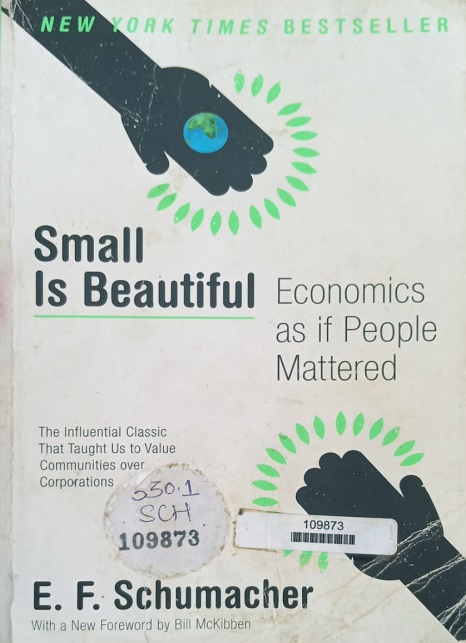
By E.F. Schumacher Ernest Friedrich
Ernest Friedrich Schumacher’s “Small is Beautiful” is an influential work that raises intense questions about modern economic beliefs and practices. Though this book was first published in 1973, it remains as relevant and impactful today as it was then in its focus on people, society and the environment, rather than just development, i.e., economic growth and profits.
Schumacher challenges the prevailing belief that “Bigger is Better” and elaborates it as “Bigger is Bitter”. He argues that large-scale industry, excessive mechanization and mass production harm both humans and nature in an exhausting manner, thereby causing destabilization. Instead, he advocates the concept of “Intermediate Technology”: small-scale, affordable and locally relevant solutions. In his insight, true progress should be measured not in GDP or national income, but in the quality of life, the dignity and the true happiness and satisfaction of people
Human Values and Economic Perspectives: Schumacher’s thinking combines economics and moral values for sustainable development. He strongly advocates for the “Mid-Way,” which is a balance between material prosperity and inner peace. He criticizes enormous, luxurious and fashionable projects and instead emphasizes local production, self-reliance and meaningful work. He believes that such small, community-based systems connect people more closely to their work, society and nature.
Development and Global Perspective: This book also covers the challenges faced by developing countries. Schumacher argues that these countries should adopt industries and technologies that are suited to their own circumstances and resources, rather than relying on large, imported technology systems. He believes that small communities and nations can build more sustainable and resilient societies by working within their own boundaries.
Lasting Impact: Small is Beautiful continues to inspire those who think mainly about the environment, sustainability and human centered economics. Schumacher’s ideas of decentralization, self-reliance and sustainable development are crucial to today’s discussions about climate change, social justice and use of technology.
Conclusion: Author’s message is vibrant, clear and significant that, the economy should serve people, not people the economy. His small, sustainable and vision with humanity can help world move toward a more harmonious and meaningful lively world. Small is Beautiful is moral and essential reading for anybody who wants to make economics more harmonious with people and nature. “Lastly, greed should be constrained so that everyone’s needs can be fulfilled.”
Ernest Friedrich Schumacher’s “Small is Beautiful” is an influential work that raises intense questions about modern economic beliefs and practices. Though this book was first published in 1973, it remains as relevant and impactful today as it was then in its focus on people, society and the environment, rather than just development, i.e., economic growth and profits.
Schumacher challenges the prevailing belief that “Bigger is Better” and elaborates it as “Bigger is Bitter”. He argues that large-scale industry, excessive mechanization and mass production harm both humans and nature in an exhausting manner, thereby causing destabilization. Instead, he advocates the concept of “Intermediate Technology”: small-scale, affordable and locally relevant solutions. In his insight, true progress should be measured not in GDP or national income, but in the quality of life, the dignity and the true happiness and satisfaction of people
Human Values and Economic Perspectives: Schumacher’s thinking combines economics and moral values for sustainable development. He strongly advocates for the “Mid-Way,” which is a balance between material prosperity and inner peace. He criticizes enormous, luxurious and fashionable projects and instead emphasizes local production, self-reliance and meaningful work. He believes that such small, community-based systems connect people more closely to their work, society and nature.
Development and Global Perspective: This book also covers the challenges faced by developing countries. Schumacher argues that these countries should adopt industries and technologies that are suited to their own circumstances and resources, rather than relying on large, imported technology systems. He believes that small communities and nations can build more sustainable and resilient societies by working within their own boundaries.
Lasting Impact: Small is Beautiful continues to inspire those who think mainly about the environment, sustainability and human centered economics. Schumacher’s ideas of decentralization, self-reliance and sustainable development are crucial to today’s discussions about climate change, social justice and use of technology.
Conclusion: Author’s message is vibrant, clear and significant that, the economy should serve people, not people the economy. His small, sustainable and vision with humanity can help world move toward a more harmonious and meaningful lively world. Small is Beautiful is moral and essential reading for anybody who wants to make economics more harmonious with people and nature. “Lastly, greed should be constrained so that everyone’s needs can be fulfilled.”
Original Title
Small Is Beautiful: Economics as if People Mattered
Subject & College
Publish Date
1973
Published Year
1973
Publisher, Place
Total Pages
324
ISBN
978-0-06-199776-1
Format
Paperback
Language
English
Reading Date
10/11/2025
Readers Feedback
Small Is Beautiful: Economics as if People Mattered
Ernest Friedrich Schumacher's “Small is Beautiful” is an influential work that raises intense questions about modern economic beliefs and practices. Though this book was first...Read More

Dr. Sachin Kulkarni
Small Is Beautiful: Economics as if People Mattered
Ernest Friedrich Schumacher’s “Small is Beautiful” is an influential work that raises intense questions about modern economic beliefs and practices. Though this book was first published in 1973, it remains as relevant and impactful today as it was then in its focus on people, society and the environment, rather than just development, i.e., economic growth and profits.
Author’s message is vibrant, clear and significant that, the economy should serve people, not people the economy. His small, sustainable and vision with humanity can help world move toward a more harmonious and meaningful lively world. Small is Beautiful is moral and essential reading for anybody who wants to make economics more harmonious with people and nature. “Lastly, greed should be constrained so that everyone’s needs can be fulfilled.”