
Availability
available
Original Title
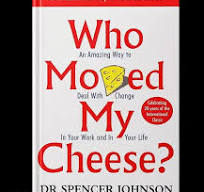
Who Moved My Cheese
Subject & College
Publish Date
1998-01-01
Published Year
1998
Publisher, Place
ISBN
9780091883768,
Format
hardcover
Language
English
Average Ratings
Readers Feedback
Who Moved My Cheese?
Yogita Gaikwad (Dalvi), Librarian, SKN Sinhgad School of Business Management Pune Spencer Johnson, M.D. left behind a medical career to write short books about life....Read More

Yogita A Dalvi
Who Moved My Cheese?
Yogita Gaikwad (Dalvi), Librarian, SKN Sinhgad School of Business Management Pune
Spencer Johnson, M.D. left behind a medical career to write short books about life. The most famous was “Who Moved My Cheese?” published in 1998. The book became a publishing phenomenon and a workplace manual. this is a motivational business fable that explores how people react to change in their lives.
The story centers around four characters—two mice (Sniff and Scurry) and two tiny people (Hem and Haw)—who live in a maze and rely on cheese as a metaphor for the things they want in life (success, happiness, wealth, etc.). One day, the cheese they depend on disappears. The mice quickly adapt, venturing out into the maze to find new cheese. On the other hand, Hem and Haw resist change. Hem stubbornly refuses to leave, paralyzed by fear and anger, while Haw gradually learns to embrace change, understanding that new opportunities lie ahead if he’s willing to move forward.
The key messages of the book include: Change is inevitable and can happen at any time.
Those who adapt quickly to change thrive, while those who resist it can be left behind.
Taking action, letting go of fear, and embracing new opportunities are crucial for personal and professional growth.
The importance of maintaining a positive attitude and not being afraid to step into the unknown.
Ultimately, the book encourages readers to reflect on their own responses to change and consider how they can better cope with life’s inevitable uncertainties.
It is a great story whom I will recommend to everyone to give to a try this will be with you for whole life.
Yogita A Dalvi
Everything changes when you change
It is an amusing and enlightening story of four characters who lived in a maze and looked for cheese to nourish them by discovering their...Read More

Harshada Mahakal
Everything changes when you change
It is an amusing and enlightening story of four characters who lived in a maze and looked for cheese to nourish them by discovering their own way to deal with change. One of the most successful business book ever, which shows how to:
• Anticipate change
• Adapt to change quickly
• Enjoy change
• Be ready to change quickly, again and again.
So, my main interest to move along with this book was the thought of change it gives to all generations and also how it tells us about how to adapt to change without harming yourself. So that you can suffer less and enjoy more.
In this book, there are four imaginary characters: two mice, “Sniff” and “Scurry,” and the little people, “Hem” and “Haw,” who spend time in a maze looking for cheese. One day they had found one C cheese station where there were so many cheeses. But the sniff and Scurry always check the remaining quantity of cheese. But slowly the cheese was getting less and, at the end, disappeared. Sniff and Scurry quickly adjusted and moved to find a new cheese station, but Hem and Haw clung to the past. Haw also started to adapt to change and join those two mice, but Hem was so touched by the past who was not able to adapt to change. Haw find many new stations of cheese. So it conclude that,
When you change what you Believe
you change what you do
The characters are too attached to real life that we are following. The cheese in your life is the job, money, etc and maze is the obstacle, where we have to find our own path to make change. Some people are able to adapt to change; some have to struggle and get there. The book is all about us. The book is simple but yet powerful.
I like this book very much due to its simple writing style. Whatever part we choose, we all share something in common, but we have to find our own way in the maze. So, beautifully imaginary characters we can relate to us. Use of metaphors like cheese and maze to show the change is awesome. There are big cheese wall photographs in the book that present small thoughts. The story is more focused on self-sufficiency, but there is a psychological aspect of Hem that had to be included, but there is nothing in the book. A book is easy to read, but also keeping a positive mindset can help people navigate change more easily.
It’s all about how, honestly, we adapt to change in our journey. I would rate the book four, however, out of five. So, without getting the influence of other’s thoughts for our decision, we must go ahead and occupy what we insist. Don’t think time will change our lives. Time only changes the expiration date of opportunities. Because,
Everything changes when you change.
Because there is no change without change…
Harshada Mahakal
Who Moved My Cheese
Mrs. Supriya Savant patil , Asst. Professor, EnTC, Sinhgad Academy of Engineering Kondhwa bk. Pune WHO MOVED MY CHEESE In last vacation I read one...Read More

Mrs. Supriya Savant patil
Who Moved My Cheese
Mrs. Supriya Savant patil , Asst. Professor, EnTC, Sinhgad Academy of Engineering Kondhwa bk. Pune
WHO MOVED MY CHEESE
In last vacation I read one fascinating book named Who Moved My Cheese? by Spencer
Johnson is a timeless, allegorical tale that explores the themes of change, adaptation, and
personal growth in both professional and personal life. Published in 1998, the book has
continued to resonate with readers worldwide, offering practical insights into how individuals
and organizations can cope with inevitable changes in their environments.
The story takes place in a maze, a metaphor for the complex and often unpredictable
landscape of life. At the heart of the story are four characters: two mice, Sniff and Scurry, and
two tiny people, Hem and Haw. The mice, driven purely by instinct, are always alert to changes
and quickly adjust when their "cheese" — a symbol of what they desire or value (such as
success, wealth, love, or security) — disappears. On the other hand, Hem and Haw, the little
people, represent the more complex human reactions to change. While Hem resists and
complains about the change, clinging to old ways of thinking, Haw learns to embrace the
situation and adapt, ultimately finding new opportunities in the process.
The central metaphor of the "cheese" is simple but powerful. The cheese represents
whatever individuals desire in life, be it material wealth, career success, or emotional fulfillment.
The maze symbolizes the environment or situation in which people pursue their goals. When the
cheese is moved or no longer available, it forces the characters to confront their fears, habits, and
assumptions about what they want and how they go about obtaining it. The message of the book
is clear: change is inevitable, and those who adapt to it are more likely to thrive.
The author’s message is particularly relevant in today’s fast-paced world, where change is
constant and often disruptive. Spencer Johnson emphasizes that while people may be resistant to
change, it is not the change itself that causes suffering, but the refusal to adapt. Hem’s reaction to
the disappearance of the cheese — his refusal to let go of the past and his unwillingness to
venture into the unknown — symbolizes the fear and anxiety many people experience when
confronted with uncertainty. In contrast, Haw’s decision to venture out and search for new
cheese exemplifies courage, optimism, and the possibility of personal growth when we let go of
our comfort zones.
Johnson’s writing style is simple and accessible, with a clear structure that makes the
book easy to follow. The book's brevity (it’s just over 90 pages) makes it a quick read, which
may be why it’s so widely popular in business and self-help circles. The lessons it offers are
straightforward, yet they prompt deep reflection on how we approach change in our lives. One of
the book’s key takeaways is the importance of anticipating change and being prepared to act
quickly when it comes. The story encourages readers to embrace the unknown and look for new
opportunities rather than cling to outdated beliefs or systems.
While the book’s message is undoubtedly valuable, some critics argue that its simplicity may
make it feel overly simplistic or even repetitive. Yet, the clarity of the story is also its strength.
Its allegorical nature allows readers to apply its lessons to their own situations, no matter their
background or profession.
In conclusion, Who Moved My Cheese? is a compelling and thought-provoking read for anyone
facing change, whether in their career, relationships, or personal goals. It offers practical advice
on how to stay positive, flexible, and open-minded in the face of uncertainty. With its universal
lessons, it serves as a reminder that change is not something to fear, but an opportunity to grow.